




A Take on Plato’s Allegory of Cave
Two worlds, Two Realities!
One soaked in the brilliance of light, another submerged in the opaqueness of darkness. That is the picture Plato paints in his Allegory of the Cave: a world inside the cave, cut off from the source of light, the sun. Prisoners are chained by their legs and necks, forced to face only the dark wall before them. Behind them burns a fragile fire, and people walk along a bridge carrying various artefacts. The flickering fire casts their shadows on the wall- shadows, the prisoners mistake for reality!
To these prisoners, the shadows are the sum of all truth. Chained by the mediocrity of life, they have developed a night vision, a comfort with their confines of knowledge, habits, and culture. They have befriended the darkness, choosing ignorance over illumination. But Plato asks, What if one prisoner is dragged outside into the glare of the sun? Her eyes ache with excruciating pain; her sight, long enslaved to illusion, rebels against the light. Truth becomes unbearable. Yet in this painful encounter, she begins to see the vast sky, birds flying, butterflies sipping nectar, nursing mothers, and children. But she also sees suffering—soldiers dying for glory, newborns lost, sickness and death!!!
This is Plato’s image of the soul’s ascent—from ignorance and illusion to knowledge and truth, from shadow to substance, from death to life. The journey toward the Good, the Real, the Absolute, demands a rupture from the familiar, the mediocrity, and the comforting fictions. To see truly is to suffer the loss of illusion. Truth is beautiful, but it is also painful. It demands “little deaths” of vanity, of fleeting pleasure, of all that is false. Through such dying comes a fuller life. Truth is not a destination one reaches upon leaving the cave; it is a struggle, a continual becoming.
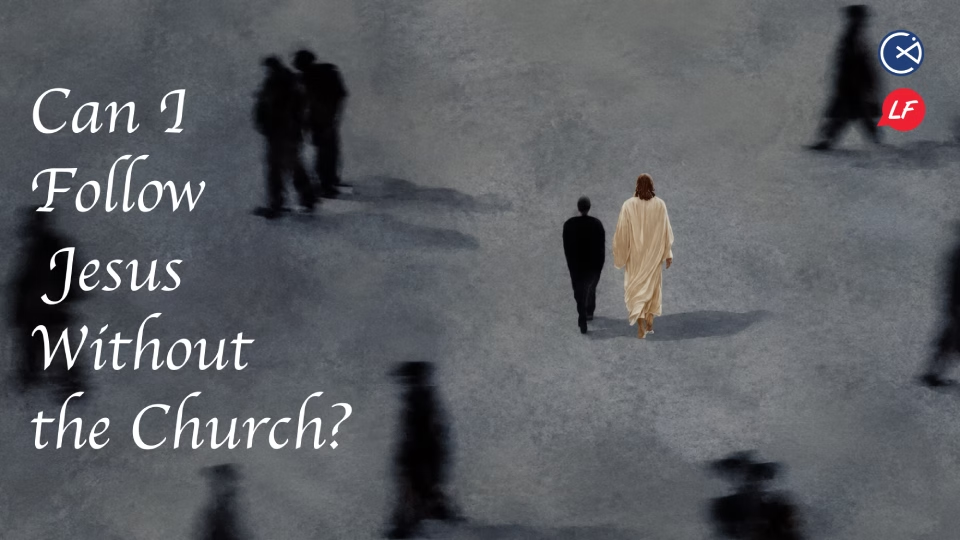
Between the two worlds of darkness and light lies a trembling grey borderland where most of us live. Here, the beam of light is faint. It is a place of transition, of partial vision, where we live between revelation and doubt. This twilight existence is a journey of becoming!
The soul’s ascent is not merely intellectual; it is deeply existential!
It is the soul’s awakening, an encounter with truth that refuses comfort. While Plato imagines the soul ascending outward, Kierkegaard reimagines this movement as inward. The cave, for him is the inner condition of untruth and self-deception. The ascent is thus not an escape into the outer world, but a descent into the self, to unshackle the inner caves of inauthentic existence —those built from fear, approval, and societal expectations.
For Kierkegaard, the soul must be torn from the chains of conformity and the comforts of inherited belief. The ascent to light is an existential rupture—a descent into the depths of subjectivity to encounter the living God. Just as Plato’s freed prisoner endures pain and wonder, Kierkegaard’s individual passes through anxiety and awakening. The light of faith, like Plato’s sun, both blinds and reveals! It exposes the limits of reason and discloses a higher reality that can only be known through inward trust.
Faith, Kierkegaard says, is not seeing the light as an object but being seized by it and allowing it to transform the structure of one’s sight. For Plato, the ascent culminates in contemplation of the Good; for Kierkegaard, it culminates in imitation of God, in lived authenticity. The one who has seen the light cannot return unchanged. The freed prisoner, mocked by those in chains, mirrors Kierkegaard’s “knight of faith,” absurd to the rational world, for faith transcends the categories of reason!
The soul’s ascent, then, is a continual awakening! A refusal to live among shadows, a willingness to bear the pain of light. Plato and Kierkegaard chart the passage from darkness to light, from untruth to truth, from death to life. Enlightenment is not a final state but a continual turning of the soul toward truth, a lifelong struggle to see, and to bear what we see.