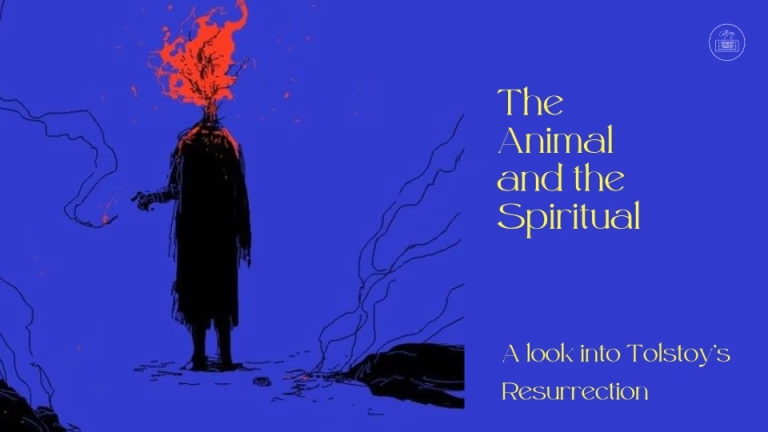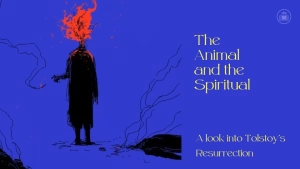





A Look into Tolstoy’s Resurrection
In every human there are two beings; the Spiritual and the Animal. While the Spiritual seeks “that kind of happiness for oneself which tends towards the happiness of all”, the Animal seeks “only one’s own happiness …, ready to sacrifice to it the happiness of the rest of the world.” Which of the two should one prefer?
Although it might seem a simple choice between the spiritual and the animal, it often proves to be difficult when faced with true realities of a world ridden with manipulation, injustice, sufferings, and mere survival. How and where does one find solace amidst all this?
Leo Tolstoy’s last work of fiction, Resurrection, published in 1899, examines these themes, among many others.
The protagonist, Prince Dmitri Ivanovich Nekhlyudov, is a reputed aristocrat, in whom we see the tussle between the spiritual and the animal. As a young man, he is a selfless lad full of life. However, as he steps into adulthood, he realizes it’s much easier to believe others than to believe the inner voice.
For the world’s approval, hence, he stifles the inner voice and indulges in whatever that’s deemed “right” by the world, letting sin enter in all forms. Without a care for the lives he was trampling in the process.
Until one day, years later, when he comes face to face with someone from his past. Katyusha Maslova was a pure, young woman who had love for everyone and everything, until her love was taken for granted by Nekhlyudov in whom the animal reigned supreme then. His lust for her leaves her impregnated, alone, and helpless. Almost shunned by the society, she eventually ends up in an establishment as a sex worker.
Meeting her again, after several years, as a sex worker and an accused in a murder case, makes Nekhlyudov guilty of his actions in the past. Resolving to right his wrongs, he sets out on a journey to get Katyusha out of prison, and to offer her a new life by marrying her.
In other words, he chooses to listen to the Spiritual in him after a long time. The path ahead was far from being an easy one. Not only because it required him to meet multiple people in power, hoping to get their approvals. But also because it made him see the harsh realities inside the four walls of the prison, and the wretched lives being led by not just the prisoners, but also the powerless in the society. He was forced to encounter the stark differences that existed between the lives led by people like him and the lives led by countless others who had neither land, nor power, nor influence.
Despite the struggles, guilt, and shame, he keeps going forward, only to get weighed down more with the bigger questions on justice, punishment, law and order, equality, among many other things. Realizing that the system is much bigger than him. In his restlessness, he finally turns to the copy of New Testament given to him by an Englishman who had come to visit the inmates.
To his surprise the verses and passages that usually used to seem incoherent, suddenly start to make sense to him:
“And it happened to Nekhlyudov as it often happens to men who are living a spiritual life. The thought that at first seemed strange, paradoxical, or even only a jest, …suddenly appeared as the simplest, truest certainty.”
“It was as though after long days of weariness and suffering he had suddenly found ease and freedom.”
What had hitherto seemed impossible and complicated, becomes the simplest, truest certainty that makes him hopeful once again. The certainty that the ultimate freedom lies in forgiveness. “to forgive, always, everyone, to forgive an infinite number of times, because there are none who are not themselves guilty…”, a precept that finally sets him free and fills him with a sense of peace. All because he finally found the courage to nurture the spiritual in him, despite what the world around him said and thought.
He doesn’t magically find solutions to his troubles. Neither does his life become instantly flawless. What he does gain, however, is clarity. And in that clarity, freedom and a new sense of meaning.
“A perfectly new life dawned that night for Nekhlyudov; not because he had entered into new conditions of life, but because everything he did after that night had a new and quite different meaning for him.”