




It is easy to assume that the doctrine of the Trinity was finished business by the Middle Ages. The great councils of the fourth century AD had done their work, the creeds were fixed, and almost everyone recited the same words on Sunday. What was left to discuss?
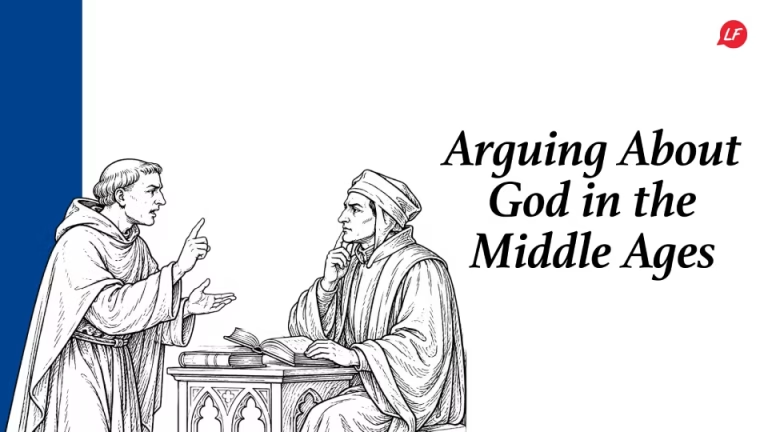
Quite a lot, as it turns out. The councils had settled what Christians must say — one God, three persons — but not how those two claims fit together. For medieval thinkers, that unfinished question was less a threat to faith than an invitation to think. Anselm of Canterbury (c. 1033–1109) popularised “faith seeking understanding”: you begin by believing, and then you think as hard as you possibly can.
Anselm himself thought hard about one of the era’s sorest points: does the Holy Spirit proceed from the Father alone, as the Greek East held, or from the Father and the Son, as the Latin West had come to say? At the Council of Bari in 1098 he defended the Western view with a chain of careful arguments. His key premise was that the three persons are identical in everything except their relations of origin — who comes from whom. If the Son and the Spirit both simply “exist from the Father” in the same way, he reasoned, nothing would distinguish them at all. The argument has weaknesses (his Greek opponents could reply that being “begotten” and “proceeding” are simply different, even if we cannot say how), but it shows the medieval conviction that even the deepest mystery should be reasoned about with rigour.
A generation later, Peter Lombard (c. 1100–1160) gathered the whole inheritance — Scripture, Augustine, the councils — into his Sentences, which became the standard theology textbook in Europe for centuries. Every aspiring theologian had to comment on it, which meant every theologian had to work through the Trinity in detail. Lombard made a precise and consequential claim: it is the persons who beget and proceed, not the shared divine nature. The Father begets; “the divine essence” does not.
That claim was attacked, most famously by the visionary abbot Joachim of Fiore, and the dispute went all the way to the Fourth Lateran Council in 1215 — the same council that shaped so much of medieval church life. The council sided with Lombard: the divine nature “is not the one begetting or the one begotten,” but the Father begets, the Son is begotten, and the Spirit proceeds, “that there may be distinction in the persons and unity in the nature.” For the first time, a technical point of Trinitarian grammar had been fixed by a general council of the medieval West.
Thomas Aquinas (c. 1225–1274) then gave the tradition its most influential synthesis. Drawing on Augustine, he pictured God’s inner life as a single, perfect act of self-knowing and self-loving: the Son proceeds like a thought, the Spirit like love. The persons, he argued, simply are subsisting relations — Fatherhood, Sonship, Procession — within the one simple God. Not everyone agreed. Franciscan thinkers, and later Duns Scotus, preferred to start from how each person originates rather than from relations, and the two schools argued brilliantly for over a century.
Why should any of this matter now? Partly because the questions have not gone away: anyone who has wondered how Christians can call themselves monotheists, or what it means to say “God is love,” is standing on ground these thinkers mapped.
But their example offers more than intellectual reassurance; there is a spiritual lesson in it too. For instance, if Aquinas was right that the persons of the Trinity are fundamentally their relations — that God’s inmost life is a communion of knowing and loving — then to be made in the image of such a God is to be made for relationship rather than isolation. For all its technicality, the medieval discussion insists that love is not merely something God does but something God is, and that a life patterned on that God will be measured less by what it holds than by how freely it gives itself away. Seen this way, the patient arguing was itself a kind of prayer: attention held long enough on the mystery to be changed by it. In an age of hot takes, it would be wise for us to listen to people who believed that the most important things deserve the most patient thought and that a mystery is not an excuse to stop thinking but a reason to keep digging deeper.
Drawn from Stephen R. Holmes, The Quest for the Trinity (2012), ch. 6; Russell L. Friedman, “Medieval Trinitarian Theology from the Late Thirteenth to the Fifteenth Centuries,” in The Oxford Handbook of the Trinity (2011); and Dale Tuggy, “History of Trinitarian Doctrines,” Stanford Encyclopedia of Philosophy.