





The significance of creeds lies in their nature as universal yet consensual, concise yet comprehensive, and succinct yet coherent declarations of the church’s doctrines. They cannot be perceived as exhaustive, but are constructive in relation to their times. Every creed in church history voices as a human witness to the event of truth. And this witness, on one hand, ought to be analyzed and examined within its specific historical framework, while on the other, it needs to be perpetually reinterpreted for contemporary times.
Karl Barth’s threefold form of the conception of the Word of God can significantly enhance our comprehension of the role of Creeds within the church. According to him, the Word of God can be envisioned as three concentric circles. The central circle represents Jesus Christ (the revelation); this central element is affirmed by the second circle, consisting of Scripture (the Bible), while the third circle comprises the proclamations of the church. It is the third circle that interests us in our pursuit of Creeds. In line with Barth’s concept of the Word, scripture stands as a primary witness to Jesus Christ, while Creeds can be rightly understood as a secondary witness to Christ and are subordinated to scripture. In other words, scripture is the predicate to the creeds, while creedal statements find their origin in scripture.
Creeds can never replace scripture, but they stand as a profound testament to the universal church throughout history. Creedal statements should not be confined solely to their theological content; they also serve to exemplify the unity of the churches as a cohesive bride. In addition to unity, they also uphold the discernment between correct doctrines and heresies. While the nature of scriptures can be regarded as the work of individual authors inspired by the Spirit, the Creeds are collective or universal declarations that unify the Church in harmony. Since the canonicity of the scriptures confers marginal control upon the church, the same principle can be observed in the creeds as well. Neither of them bypasses human limitations, yet God chose to work through these means, and thus, they are trustworthy as long as they are grounded in Christ and illumined by the Holy Spirit. In other words, the authority of Creeds lies in the authority of the universal church.
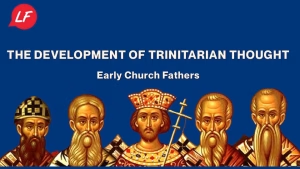
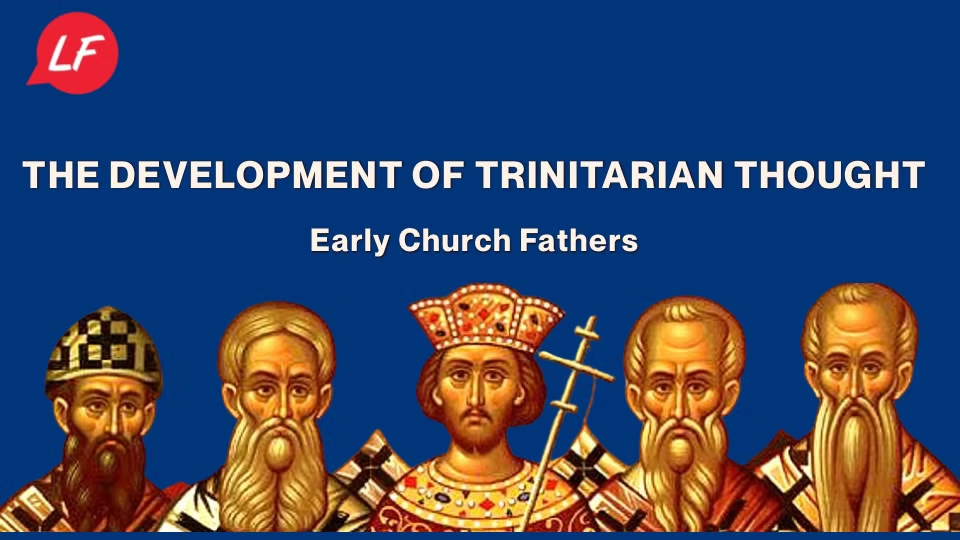
A brief overview of the three renowned creeds is as follows. The Apostles’ Creed succinctly encapsulates the teachings of the Apostles, primarily delineating two dialectical movements: the descent of the Son from the Trinity to the humanity of Christ, including his descent to earth, the cross, and hell, followed by an upward movement toward resurrection, ascension, and heaven. This progression culminates in the judgment of all, with an emphasis on the establishment of the Church, and concludes with the promise of everlasting life.
The Niceno-Constantinopolitan Creed also commences with an emphasis on the Holy Trinity, highlighting the shared essence between the Father and the Son. It then advances with a similar ascending progression concerning Christ, incorporating references to the Church and the coming age. Conversely, the Chalcedonian Creed begins and concludes with Christological assertions, emphasizing the validity of Christ’s dual natures—divine and human—and advocates for their harmony by employing negative terminology such as confusion, change, division, and separation. Thus, the Apostles’ Creed and the Niceno-Constantinopolitan Creed primarily emphasize the doctrine of the Trinity, whereas the Chalcedonian Creed focuses predominantly on Christology.