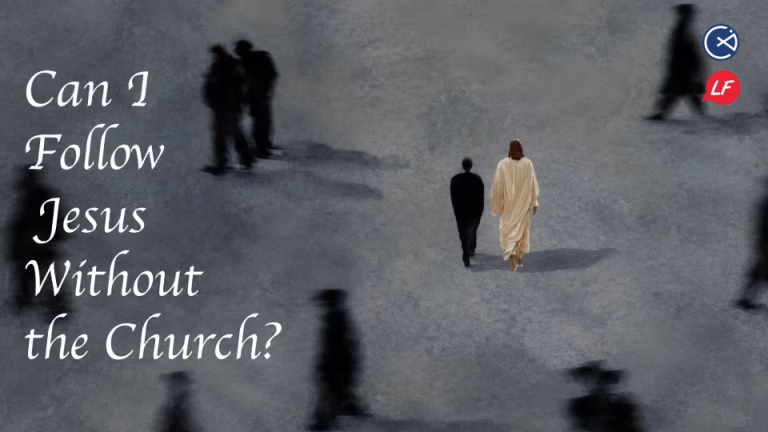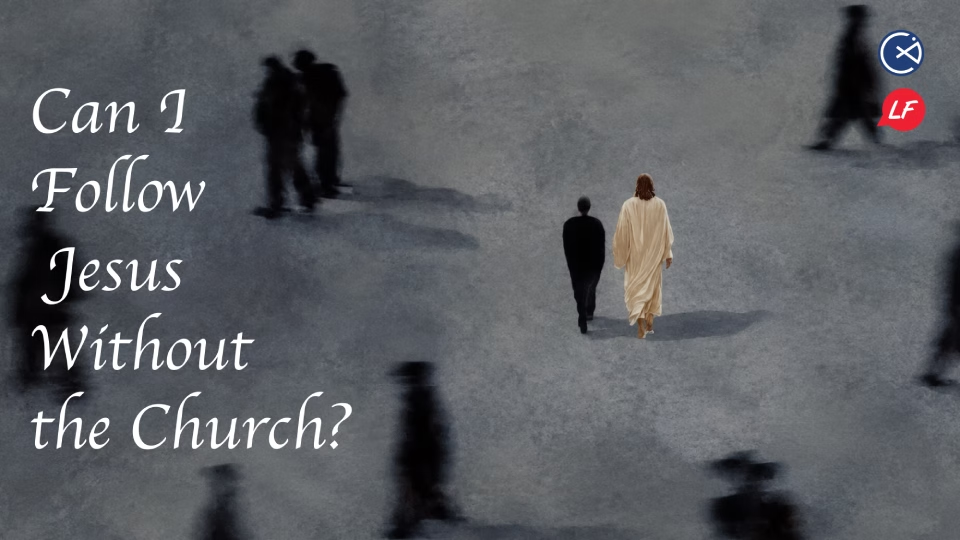





Can I Follow Jesus Without the Church?
One of the most common questions of modern faith is this: Can I follow Christ without the church? And it is a sincere one. Many people love Jesus but have grown tired of the church. Some have been hurt by people they trusted. Some have experienced hypocrisy, spiritual burnout, or leadership failures. Some have felt unseen, judged, or simply as though they never really belonged. Others carry difficult questions about faith and have found that the church was not always a safe place to ask them. And for some, after years of disappointment, faith simply feels quieter and safer when practiced alone.
This struggle deserves a real response, and Scripture gives us one. It is not simply a rule about attendance. It is a question of what it means to belong to Christ in the first place.
Salvation Is a Gift, and Belonging Is Part of the Gift
No one is saved by attending church. We are saved “by grace through faith,” and not by anything we do (Ephesians 2:8–9). The thief on the cross entered paradise without joining a congregation (Luke 23:43). But in the same chapter of Ephesians, we see that those who are saved are now “fellow citizens with the saints and members of the household of God” (Ephesians 2:19). The same grace that reconciles us to God also brings us into His household.
Christ has staked his heart on the church
Jesus did not say he would save individuals and leave them to organize themselves. He said, “I will build my church” (Matthew 16:18). Paul adds that “Christ loved the church and gave himself up for her” (Ephesians 5:25). When Saul was persecuting believers, the risen Christ asked him, “Why are you persecuting me?” (Acts 9:4). Jesus counts what happens to his people as happening to himself. To love the Head while dismissing the body he built, died for, and is present in is to love a Jesus of our own making.
The Body leaves no room for a detached believer
Paul’s favorite image makes the point with great force. “In one Spirit we were all baptized into one body” (1 Corinthians 12:13). The Spirit who joins a believer to Christ joins that believer to every other believer. These are not two works but one. Romans 12:5 says we are “individually members one of another.” A hand cannot be attached to the Head and detached from the body, and a hand cut off is not freer. It is lifeless.
There is a deeper reason beneath this. In John 17:21 Jesus prays that his people “may all be one, just as you, Father, are in me, and I in you.” The church’s unity is meant to echo the life of God himself, who is not solitude but communion. To live disconnected from God’s people is to live out of step with the God who is, in himself, a fellowship of persons.
What the Body gives that you cannot give yourself
Christ gave shepherds and teachers so that we would grow into maturity and no longer be “tossed to and fro by the waves” of every doctrine (Ephesians 4:11-14). Growth happens in company.
The church also protects: Paul warned the Ephesian elders that wolves would come, and a flock watched by shepherds and by each other is safer than a sheep alone (Acts 20:28-29). The church helps us persevere: “Exhort one another every day… that none of you may be hardened by the deceitfulness of sin” (Hebrews 3:13).
The gift also runs the other way. Spiritual gifts are given “for the common good” (1 Corinthians 12:7). When a believer stays away, the loss is not only theirs. Someone in the body is missing what God gave that person to give.
What the world sees
“By this all people will know that you are my disciples, if you have love for one another” (John 13:35). Love for one another is visible only where there is an “another.” A scattered collection of private believers cannot display it. Jesus tied the world’s belief to the visible unity of his people (John 17:21). The church is not a side project of the gospel. It is the gospel made visible, because a reconciled community is the proof that the message is true.
But what about the church that hurt me?
The honest objection deserves honest care. Where a church has wounded someone, that grief is real, and Scripture does not ask anyone to pretend otherwise. Corinth was a troubled church, marked by division and disorder. Yet Paul addressed them as “those sanctified in Christ Jesus” (1 Corinthians 1:2) and told them, “you are the body of Christ and individually members of it” (12:27). His answer to a flawed church was never to leave the body but to heal it. A broken limb is not cured by amputation. Sometimes healing means finding a different congregation, but it still means finding one.
The Bride He is preparing
Christ is not preparing a scattered crowd of private believers. He is preparing a Bride, washing her “with the word, so that he might present the church to himself in splendor, without spot or wrinkle” (Ephesians 5:26-27). The imperfect church you sit among this week is that Bride in the making. Following Jesus without the church is not what he designed, because he did not save us to follow him alone. He saved us to follow him together, toward the day when his people are presented to him in glory.