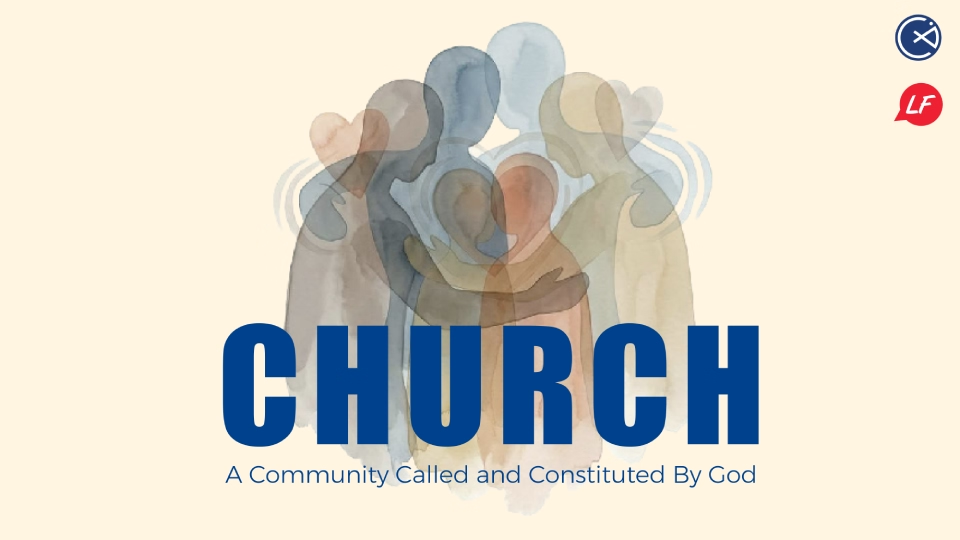





The term “Church” is a translation of the Greek word “ekklesia,” meaning “assembly.” Its etymology, “called out,” carries a theological connotation with the biblical idea of God calling and gathering a people for himself. The church, therefore, constitutes an assembly of people who are called by God to belong to Him.
The calling began with God, who established a covenant with the Israelites, declared in the covenant formula: “I will be your God, and you will be my people,” at Mount Sinai following the Exodus. This covenant became foundational to Israel’s identity as the “people of God.” The Hebrew term “Qahal” and the expression “Qahal El” describe Israel’s covenant community in the Old Testament, portraying it as an “assembly or congregation of God.”
The New Testament redefines the understanding of the “people of God” in light of the New Covenant inaugurated by Christ. Through His life, death, and resurrection, Christ assembles a people to Himself, extending God’s covenant beyond one ethnic or national identity.
The Church represents a community of grace, brought forth in history through God’s merciful action in Christ. In the Gospels, Jesus declared that He would build His church upon the confession that “Jesus is Lord.” At the cross, Jesus accomplished what humanity could not do for itself by delivering people from the bondage of sin and death. The Church consequently becomes a community that receives the gift of forgiveness and responds to God’s merciful work in submission to the Lordship of Christ, living according to God’s word empowered through the gift of the Holy Spirit.
The Church is not merely a human institution or a gathering of individuals but is constituted by God’s presence. The Church participates in the prophetic hope of the New Covenant, a people envisioned by prophets whose sins are forgiven, whose relationship with God is restored, whose hearts are transformed, and in whom the Spirit of God dwells. Hence, the Church is a continuation of the biblical story, whose meaning and existence come from belonging to God through faith in Jesus Christ according to God’s eternal purpose.
As Paul writes in 1 Corinthians 12: 27, Christ is the head of the church, and believers are the members of this body; thus, the Christian community is relational in its nature. The Church’s identity lies not in architecture but in God’s people coming together, having the same mindset of Christ, following his self-emptying model by surrendering personal rights and privileges for the common good.
The calling of the Church has always been countercultural, embodying kingdom values and living a cruciform lifestyle. For instance, the early church was a colony of God’s people living within a competitive, status-driven Roman society where social distinctions were challenged as every person, be it slave or free person, Jew, or Gentile, male or female, was made one in Christ.
In today’s context, being the Church of Christ means refusing to conform to the goals of an individualistic society. Instead, we must rethink our entire purpose and understanding of existence, reshaping our worldview through the lens of Christ’s self-giving love. By embodying the love of Christ in both word and deed, the church becomes a visible expression of the Christ’s presence in the world.